

Concept
Japan is said to be one of the world's most forested countries, with 70% of its land covered by forests.
However, the wood self-sufficiency rate is low at 41.1%, ranking low even among developed countries.
One of the reasons is that after the war, many cheap materials were imported from overseas and continued to be used.
Domestic forestry and lumber industries declined, and no lumber appeared on the market.
In addition, coniferous trees such as cedar and cypress, which account for 70% of the forest, were planted for construction purposes after the war.
It is no longer used due to the increased demand for buildings made of reinforcing steel and plasterboard.
Furthermore, even when wood was used for furniture, it lost its value due to its weak strength, and the forest fell into disrepair.
Therefore, in order to connect Japanese trees to the future, I came up with the idea of creating a picture book made of wood,''Kinoehon''
There are a total of 10 volumes of picture book stories, all of which are stories related to Tottori Prefecture in Japan, where the tree grew.
Let children living in the future read picture books made of wood.
I created a picture book that you can feel with all five senses, such as the story, the colors, the feel of the wood, the scent, and the tactile sensation.
I hope that the children will learn more about trees, forests, and Tottori Prefecture, where the trees were grown.
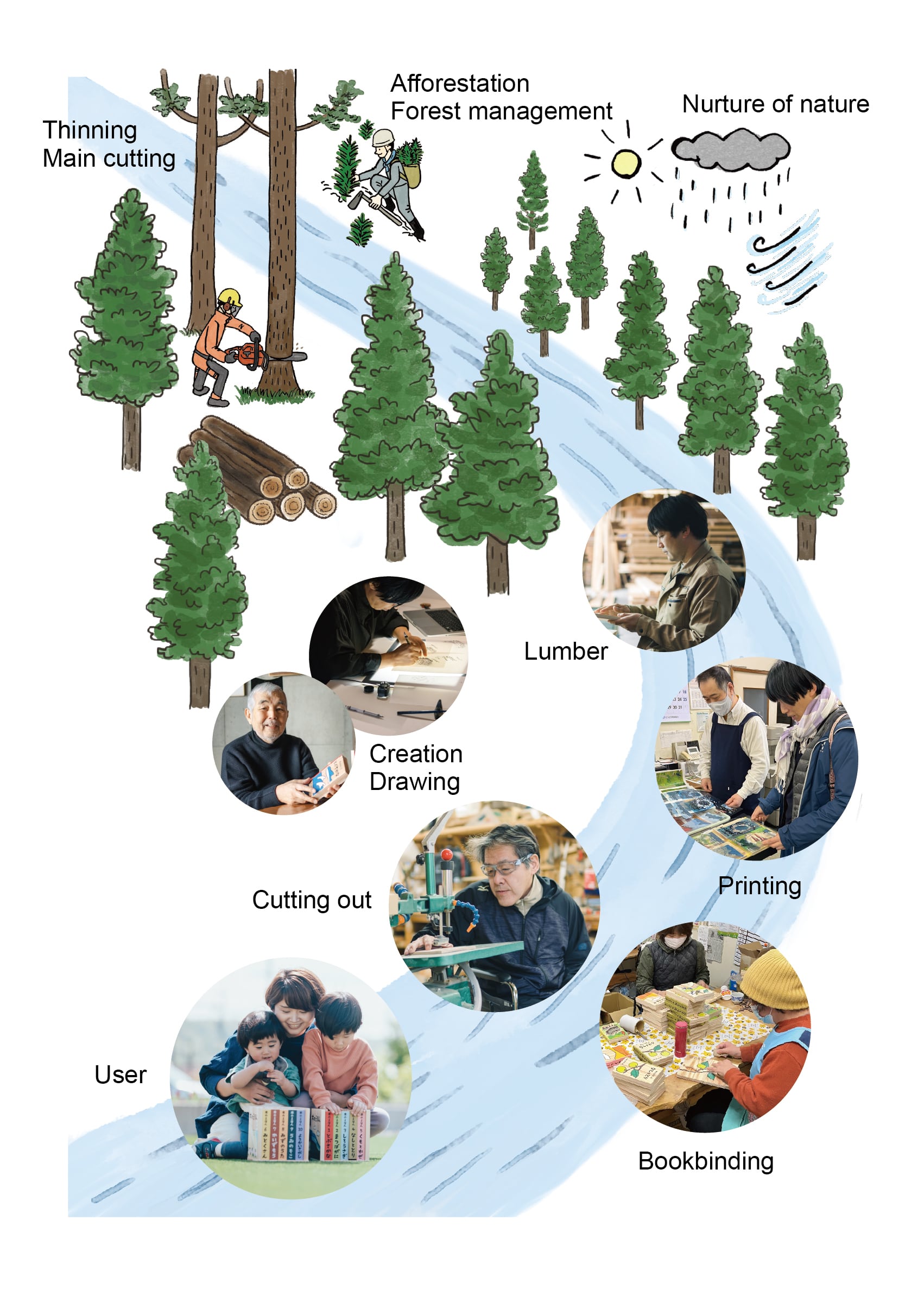
''Kinoehon'' production process
The entire production process for the ''Kinoehon'' is carried out in Tottori Prefecture. Because we are a small prefecture, we connected with the desire to create something really good, and I am confident that this book helped us realize that desire.
The ''Kinoehon'' is made of cedar wood. The beautiful cedar has been carefully pruned to prevent knots from appearing, and you can enjoy the grain of the wood depending on the part. One of the characteristics of cedar is that its soft parts, which are 70 to 80 years old, synchronize with human body temperature and quickly adapt to human skin. The softness makes it suitable for children to hold. Normally, when the wood is sawn to a thickness of 7 mm each, it tends to warp easily when it dries, but we have used our extensive experience and skill with cedar to process it so that it is less likely to warp.
And we use Japanese paper for the spine of the book. Washi paper is a material that has been used for a long time and is extremely strong and durable.
The printing is also devised to take advantage of the quality of wood and washi paper. We use a UV printer that fixes the ink with ultraviolet light. You can add colorful colors while preserving the beauty of the wood grain, creating a soft finish. We also use safe and reliable paints.
Finishing processing and bookbinding are performed at a workplace for people with disabled person. The ''Kinoehon'' is a three-dimensional picture book with the main character cut out, so detailed work is required to make it turn smoothly. The cutting angle changes slightly depending on the shape and size, so it is a very nerve-wracking process. This kind of processing is done skillfully using only one right hand.
In this way, each ''Kinoehon'' filled with materials, printing, processing, and thought is delivered to children.
Production episode

Author of volumes 1-5
Hyo Shiraoka
There are certain things that I have cherished in my career as a furniture designer. It means being interested in everything, discovering things from there, and creating. The feeling that fills your heart at that moment is a fundamental human desire, and I think it's the same for both children and adults.
This ''Kinoehon'' was created so that children can expand their imaginations and adults can enjoy reading it as well. The story I drew is related to the eastern part of Tottori Prefecture, where I live. Tottori's rich nature, the various living creatures and high-quality materials produced there, and the culture of weaving by its people are still alive and well. While letting children learn about the wonders of these local resources, they will also learn about the themes in the story of ''discovery,'' ''exchange,'' ''creation,'' ''activation,'' and ''evaluation,'' which are important in people's lives. I hope it will be something that can be communicated.
For children, the memories of what they were exposed to when they were young will remain forever. That's why we are particular about using materials that Tottori is proud of. The book is bound using four sheets of 7mm thick Chizu cedar, a tradition inherited from the Edo period, and using Inshu washi paper as the cornerstone. cedar, which has the scent of the forest, has a soft texture, a warmth that feels on the skin, and a beautiful grain that shows each piece a different expression. In addition, we created a mechanism to cut out the main character in this three-dimensional picture book. As the story progresses, the protagonists run through the majestic nature. While enjoying the story, children may think of various ways to play, such as peeking through the cut-out parts or holding something in between. How you play is up to you. Stimulating children's limitless imagination.
I hope that this picture book will reach children all over Japan, or even around the world, and that it will reach the hearts of people living in all eras, and that it will be an opportunity for them to learn about the small region of Tottori.
Production episode

Author of volumes 6-10
Ayumi Kimoto
When I was a child, I loved imagining what kinds of stories existed in the natural world. When creating this drawing, I thought about how I could portray what I was enjoying in my head through a picture book.
I have continued the free worldview of the stories in volumes 1 to 5, and in volumes 6 to 10 I have added my own interpretation to the stories imagined from the nature of Tottori. I don't think it's a coincidence that water, which I am deeply interested in on a daily basis, has appeared all over the place. Furthermore, as I researched the theme in more detail, I realized that! I have also added actual information that moved me. By focusing on the deeper aspects of Tottori rather than just looking at the surface, and by going one step further and experiencing things that I didn't know about even though I live in Tottori, I feel like I'll be able to discover new charms of Tottori.
When I was thinking about the story, I went on a trip to Cambodia. Having had many experiences that overturned the stereotypes I had previously held, I became acutely aware that the meaning of things changes when you look at them from a different perspective. From that experience, what I valued when creating this work was ``creating blank space.'' This is like this! I didn't say it outright, but instead tried to give it to the reader, expand their imagination, and have them think about it further. There is no correct answer to the story. I would be happy if people could enjoy expanding their feelings, thoughts, and stories from their own perspectives. Also, I secretly put something like a trick inside the picture book. I'm looking forward to seeing how much people will notice it, and I'd be happy if people enjoyed the picture book to the fullest, thinking there might be something new to it.
Unlike paper picture books, this ``wood picture book'' is full of Tottori's materials, techniques, and handiwork, and it feels more like a manufactured product, which makes it appealing. The sawing, printing, and processing is done one by one with the hearts, eyes, and hands of people, and the material cedar continues to live by responding to humidity and temperature, so each piece is never the same and grows even more in the hands of the reader. I think it's fun to continue and add time.

When I read "Wood Picture Book," along with the simple, heartwarming story, I felt an indescribable sense of nostalgia from the pleasant feel of the wood. Not only did it feel comfortable in my hands, but I also felt the strength of Chizu cedar. I believe this will have a very positive impact on children. Childhood is a time when senses and sensibilities are developed. I can imagine children enjoying this book as their interests dictate: looking at the colorful pictures, listening to the voice reading, touching it with their hands, and smelling it. I think the great thing about this book is that it can be enjoyed with all five senses, all the more because it is made from high-quality materials.
When I was an elementary school principal, I was always amazed at children's imagination and creativity. Even adults can learn a lot by reading it, but children don't just stick to common sense; they expand the story in their heads, asking questions like, "What is this?" and "Maybe it continues like this." I think this is a book that will take both children and adults into a world of imagination.
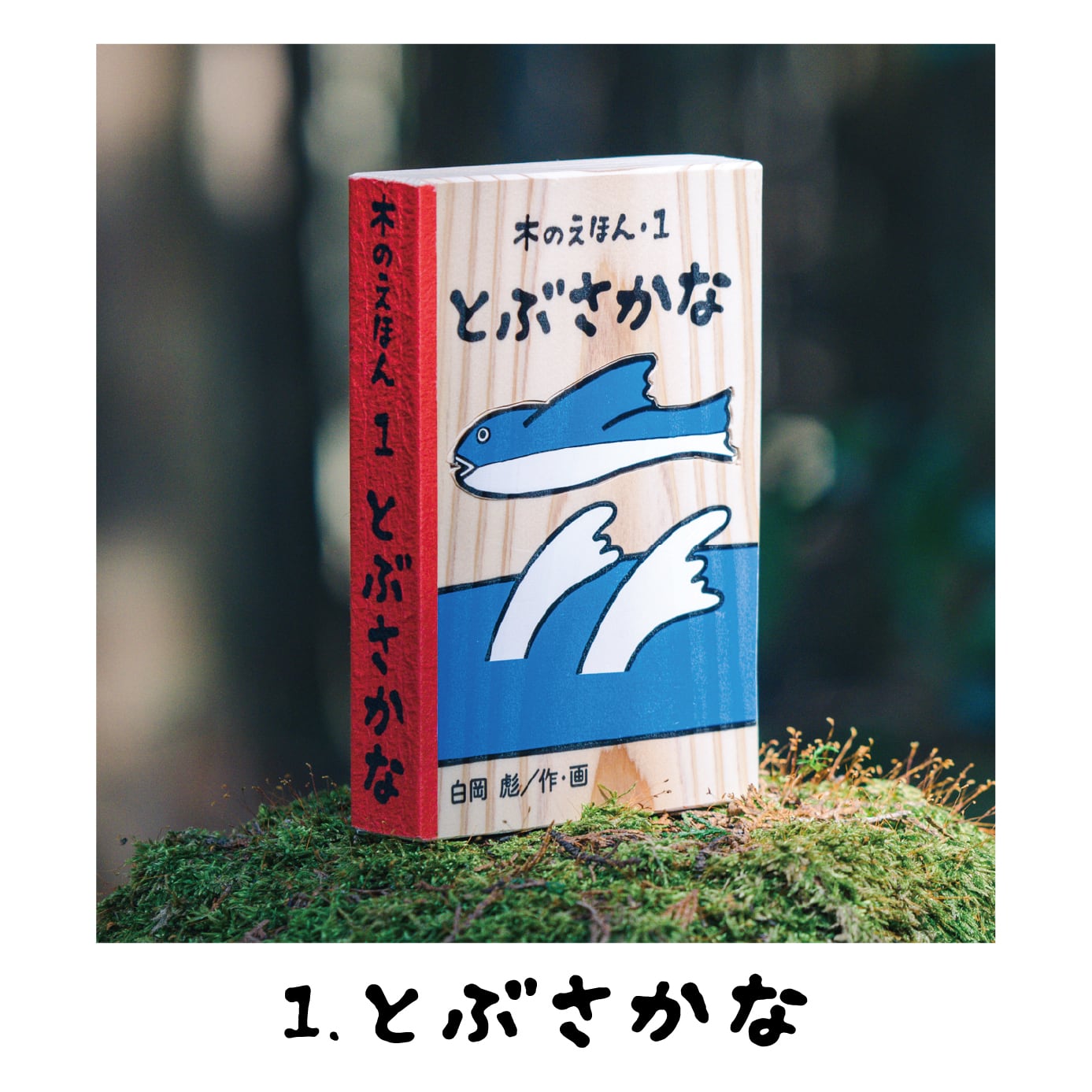
Story. 1 '' TOBU SAKANA ''
Flying fish that live in the Sea of Japan,
A story about discovering a red fish swimming on top of a mountain.

Story. 2 '' MATSUBA GANI ''
Matsuba crab living in the Sea of Japan,
A story about the interaction between mountain freshwater crabs that live in rivers.

Story. 3 '' SHIROUSAGI ''
The White Rabbit of Inaba encounters various landscapes, A story about creating colors.
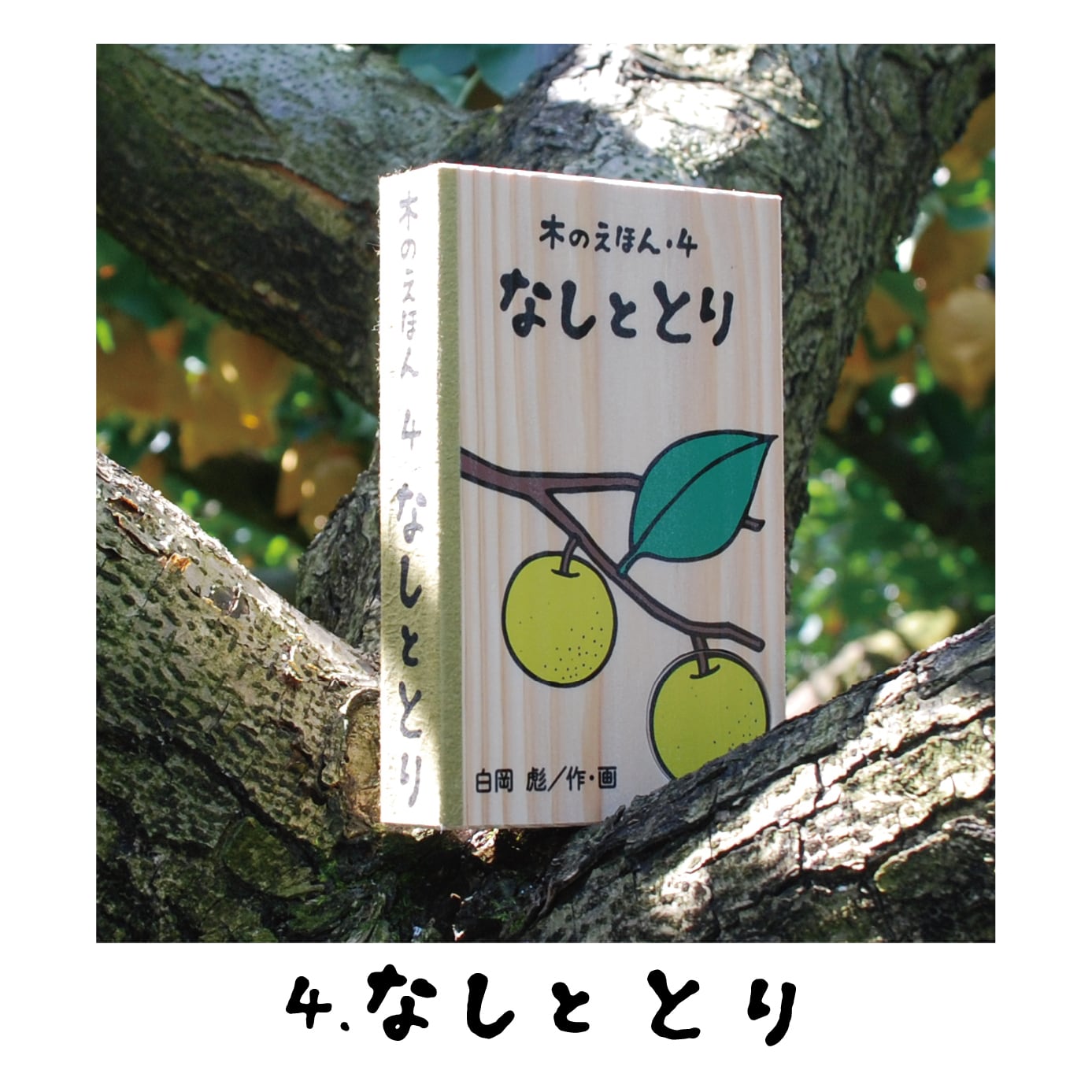
Story. 4 '' NASHI to TORI ''
Mountain bird and 20th century pear
A story of humorous dialogue.

Story. 5 '' KUMO to KAZE ''
A mountain bird that flew to Tottori Sand Dunes,A moving story about the power of clouds and wind.

Story. 6 '' MITOKUSAN ''
Nageire-do, which is still shrouded in mystery.
The story of a sculpin frog who witnessed a secret.

Story. 7 '' KAIZUMOU ''
Shellfish living in various waters gather on the beach, A story about a competition of strength at a sumo tournament.

Story. 8 '' MIZU no UTA ''
A joyful song of water flowing through
Mt. Daisen, A story that a giant salamander listens to.

Story. 9 '' UMI no SOKO ''
Creatures that live in the deep sea of the Sea of Japan, A story about a lively meeting at the well.
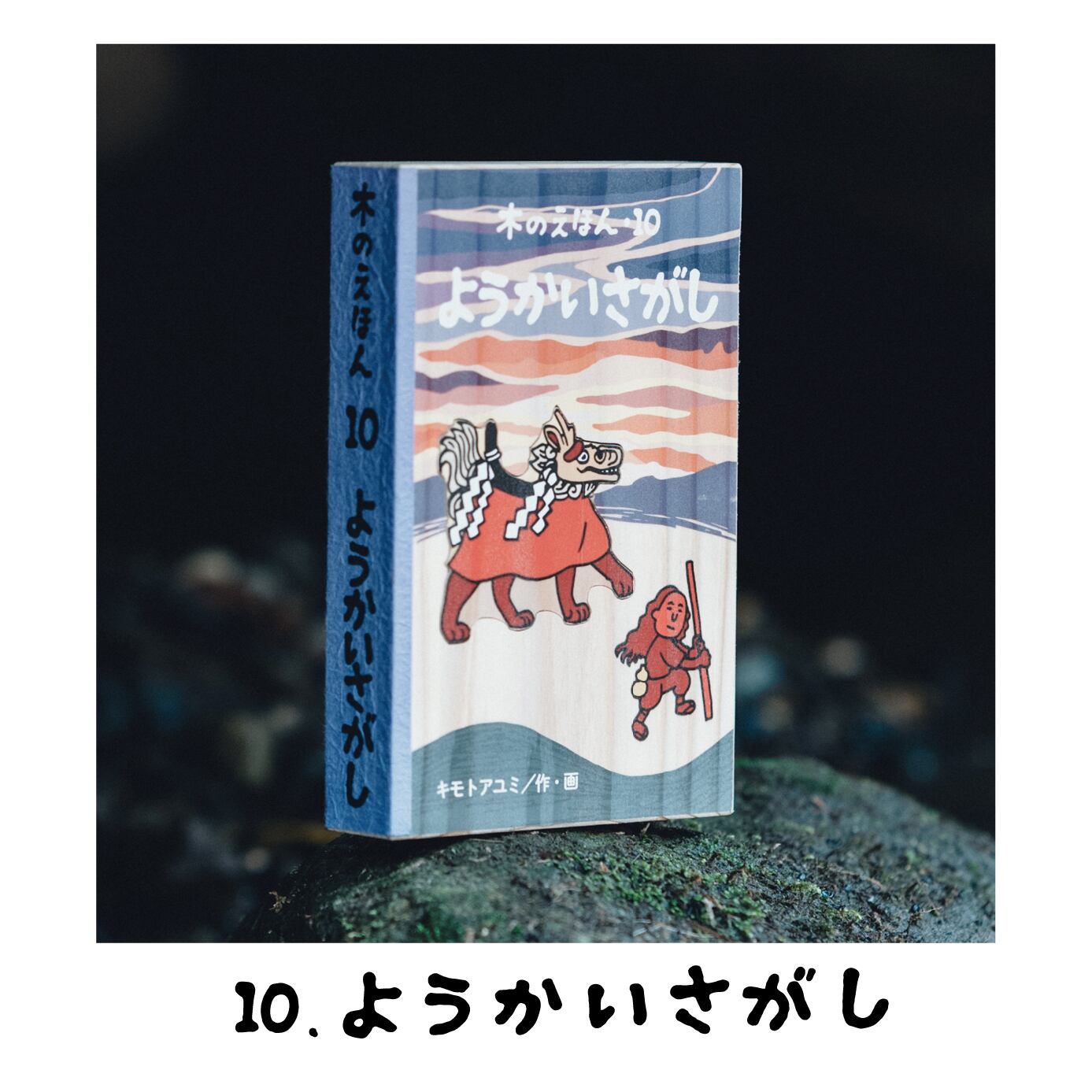
Story. 10 '' YOUKAISAGASHI ''
A group of '' Kirinjishi '' west of Tottori. A story about a journey to find a monster.